

About Context Panel#
Supported platforms: Exchange Server
 Microsoft 365
 Google
Context Panel lets you access and manage Salesforce data directly from Outlook or Gmail. You can view, create, and update Salesforce records, save emails and attachments, and work with CRM data without switching between applications or manually copying information.
Context Panel interface#
Outlook ribbon commands#
After you install Context Panel, the following Revenue Grid commands become available in the Outlook ribbon:
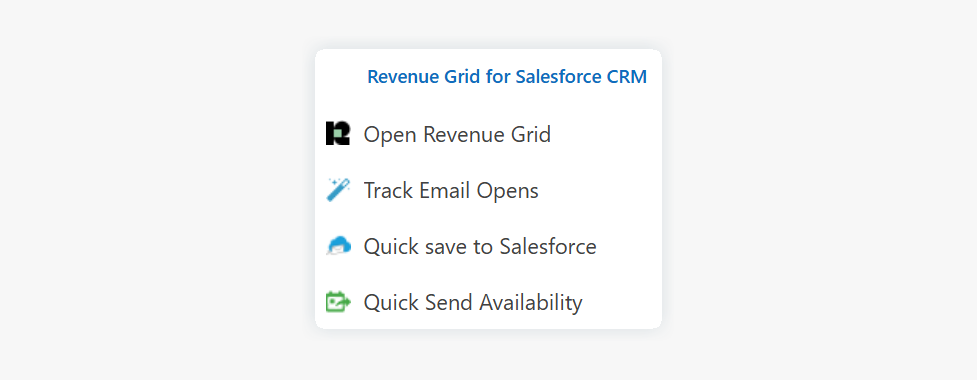
The first three commands are available when reading or composing emails. Track Email Opens is available only when composing emails.
Context Panel elements#
The following screenshot highlights the main Context Panel elements and controls.
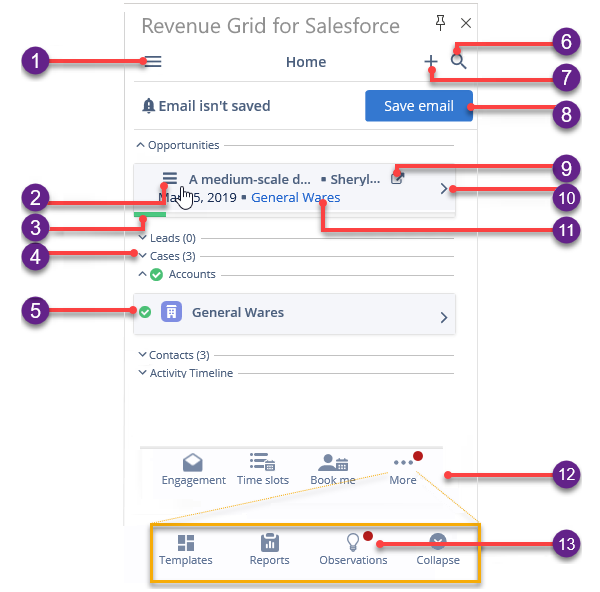
Menu icon. Click to open the Context Panel menu, where you can access your profile, settings, support resources, and other options.
Record actions menu. Hover over a record to display the available actions.
Opportunity progress indicator. Shows the current stage of an opportunity.
Record category. Click to expand or collapse a record category.
Green checkmark. Indicates that a record or category is already linked to the current email or calendar event. Click it to view the latest associated activity.
Search icon. Click to search for Salesforce records.
Create icon (+). Click to create a new Salesforce record.
Save email / Save event button. Click to save an email or calendar event to Salesforce.
If the item is already saved in Salesforce, the button changes to Email is saved or Event is saved. Click it to open the corresponding Salesforce record in the Context Panel.
Open in Salesforce icon. Click to open the record directly in Salesforce.
Record details arrow. Click to expand the record card and view its details.
Related account link. Click the account name to open the associated Salesforce account record in Context Panel.
Smart Actions toolbar. Provides quick access to frequently used features:
Engagement – View email open statistics.
Time slots – Send available meeting time slots.
Book me – Share your calendar availability.
Templates – Reply using a Salesforce email template.
Reports – Access Salesforce reports.
Signals – Open Revenue Grid Signals.
Observations. Part of the Smart Actions toolbar. Displays information about required setup actions, synchronization status, and checks performed by Context Panel. Examples include identifying internal or blocklisted email addresses, suggesting record merges, and prompting you to authorize Microsoft Exchange Server or Microsoft 365 access for Context Sync.
Hint
You can zoom in on the Context Panel as you would on a web page. To do this, click inside the Context Panel, hold down Ctrl (Windows) or Command (Mac), and scroll up with your mouse wheel. The Context Panel components increase in size and adjust their layout accordingly.
Context Panel menu#
Click the menu icon in the upper-left corner of Context Panel to access the following options:
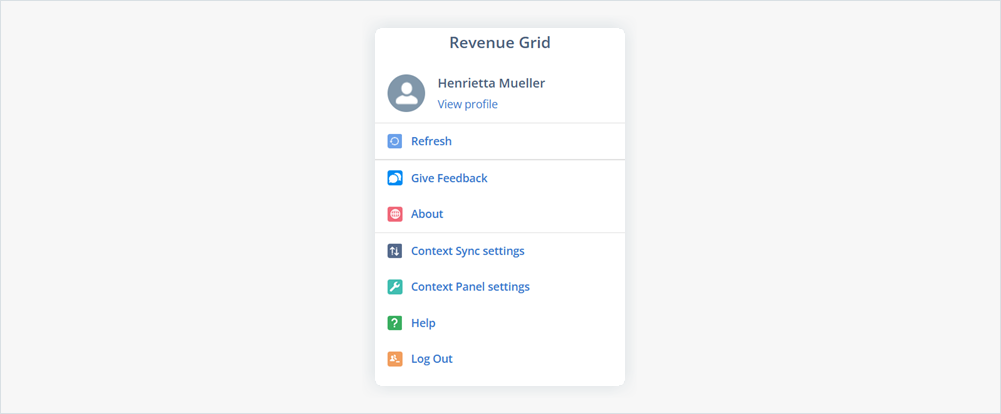
View profile – Opens your Salesforce profile.
Refresh – Reloads Context Panel.
Give Feedback – Lets you report an issue or suggest an improvement.
About – Displays the application version and subscription details.
Context Panel settings – Opens Context Panel settings.
Context Sync settings – Opens Context Sync settings.
Help – Opens the Revenue Grid knowledge base.
Log Out – Signs you out of your Revenue Grid account.
Context Panel features#
View relevant Salesforce records. Context Panel automatically retrieves Salesforce records related to the selected email or calendar event and displays them directly in Outlook or Gmail. These include contacts, leads, accounts, opportunities, cases, custom objects, related activities, and attachments.
Save emails to Salesforce. Save emails using the Context Panel Save dialog and link them to relevant Salesforce records. Depending on your configuration, emails are saved as completed tasks or EmailMessage records (Enhanced Email). You can also save email attachments to Salesforce.
Create and update Salesforce records. Create new records or edit existing ones, including custom Salesforce objects, without leaving Outlook or Gmail. Context Panel can also automatically prefill certain fields with information extracted from emails when you save items or create records.
Search for Salesforce records. Find Salesforce records directly from Outlook or Gmail to view their details or link them to emails and calendar events. Search across multiple record types or narrow your search to a specific type. Available records depend on your enabled Salesforce list views and Context Panel settings.
Track customer engagement. Use the Engagement Smart Action to see when and where recipients opened your tracked emails, how many times they opened them, and whether they clicked tracked links.
Customize Context Panel. Configure which Salesforce objects and fields appear in the Context Panel and which records are retrieved from Salesforce. You can customize the display of both standard and custom Salesforce objects to match your workflow.
Localizations#
Revenue Grid supports 16 languages across its interfaces, including Context Panel and the Revenue Grid platform. These language options are available to all users in your organization.
Chinese Standard Simplified (Mandarin)
Chinese Traditional (Taiwan)
Czech
Danish (Denmark)
Dutch (Netherlands)
English (USA)
French (France)
French (Canada)
German (Germany)
Italian
Japanese Simplified
Korean (South Korea)
Norwegian (Bokmål)
Portuguese (Brazil)
Portuguese (Portugal)
Spanish (Latin America)
Spanish (Spain)
For details, see User interface localizations.