

Handling synchronization issues#
Supported platforms: Exchange Server
 Microsoft 365
 Google
When using Context Sync, sometimes you may encounter particular data synchronization issues that can block syncing of certain items or even disable the synchronization completely.
This article provides a detailed overview of how to identify and investigate synchronization issues and ways to address them.
Identify synchronization issues#
There are several ways how you can find out that a sync issue has occurred and some data failed to be synchronized between your mailbox and Salesforce.
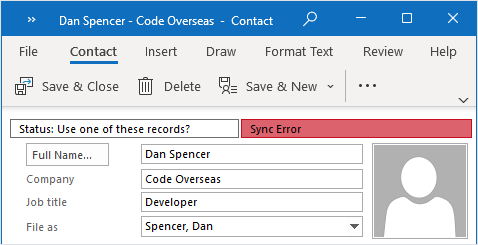
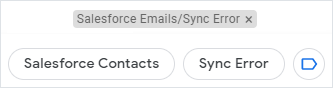
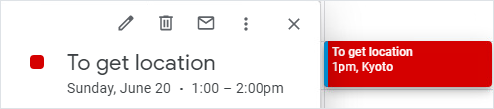
As a first sign of a synchronization issue, Context Sync will mark an affected object in your mailbox with a custom category, label, or color to let you know about it:
In Outlook, the item for which a sync issue occurred is assigned two custom categories: a red Sync Error category and a white category providing extra details.
In Gmail of Google Calendar, the item for which a sync issue occurred is assigned a custom label Sync Error or a red marker for calendar items.
Another way to identify sync issues is to check the logged data on the Context Sync settings page. Revenue Grid logs all occurred synchronization issues and errors in Context Sync settings, providing an ability to monitor, investigate, and resolve them efficiently.
In addition, all issues are also registered in Revenue Grid administration settings for monitoring and resolution by the local admin.
Investigate synchronization issues#
When Context Sync encounters conflicts between synchronized data sources or is unable to run synchronization to less obvious reasons, all synchronization issues details are reflected in Context Sync settings on the General and Issues tabs.
To conduct an issue investigation, you need to check the logged information, which can include the issue cause description, advice for resolving it, or a sync error code.
General tab#
On the General tab in Context Sync settings, you can check the synchronization status, the last sync session details, as well as sync error messages if any occurred.
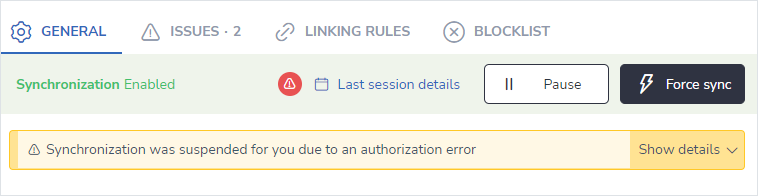
Click Last session details to view the logged information about the last synchronization. Also, use the Refresh button to update the details if another sync session has run recently.
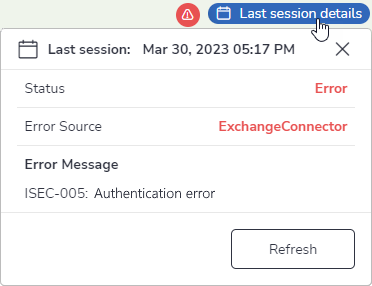
If there is a sync error message, click Show details to see the detailed error description and recommendations on how to address it, when available.
Issues tab#
On the Issues tab, you can find the issue’s log, which usually includes a sync error code or notification returned by Context Sync and indicates the source of the error, date and time when the error occurred.
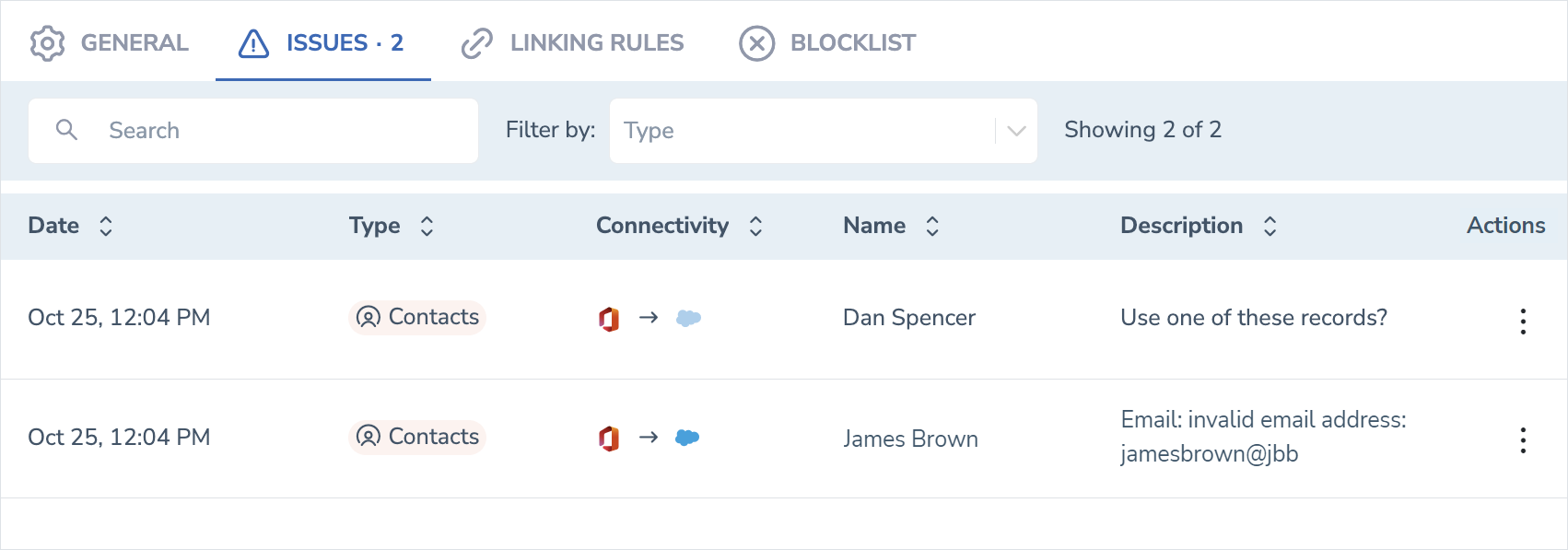
Hint
You can instantly view the Salesforce or Microsoft Exchange Server / Microsoft 365 / Google record that caused the issue by clicking the mail client or Salesforce icon under Connectivity.
Account credentials changed#
When your Salesforce or Microsoft Exchange Server / Microsoft 365 / Google credentials are changed, Revenue Grid can no longer access your data, and the corresponding sync error message appears on the General tab in Context Sync settings.
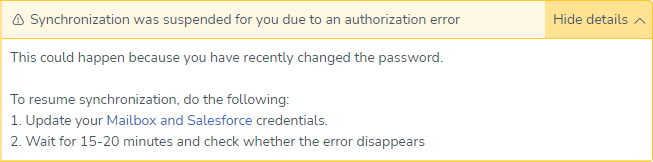
Also, refer to the Credentials renewing section below for more information.
In addition, for cases when Revenue Grid is unable to access your Salesforce or mailbox data or when data syncing fails 10 times consecutively, you will receive a notification email informing you about the need for action to resolve the issue and resume data syncing.
Resolve synchronization issues#
Once you investigate the sync issue, you need to follow the handling recommendations described in the issue details. If there are no recommendations, proceed with the following steps to address it:
If the issue occurred because required data was missing or invalid data was entered into some field, enter or correct the corresponding data
If the issue occurred due to authorization problems, refer to the Credentials renewing section below for a solution
If the issue has an error code, consult the table of sync error codes for a solution
For the cases when you or your admin cannot resolve an issue locally, it is recommended to contact Revenue Grid Support:
On the Issues tab, click the more icon under Actions, click Chat with support, and send a report to Revenue Grid Support. Make sure to include details and screenshots, when applicable.
Important
Note that when you are using Context Sync and Context Panel there should be no other software running that performs data transfer between Microsoft Exchange or Google and Salesforce API (e.g. Salesforce Lightning sync, Salesforce Inbox, Salesforce for Outlook, etc.) Running different sync applications simultaneously will cause sync conflicts and items duplication. If you encounter this kind of unexpected behavior, please check that with your Salesforce admin or, if you are a Salesforce admin, check for such software in the following places:
Salesforce Setup > Apps > App Manager
Salesforce Login History. After you find apps which cause sync conflicts, please refer to this Salesforce help article to learn how to disable them. Please also note that apps which use Salesforce API but do not exchange data between Salesforce and Microsoft Exchange / Google will not cause sync conflicts.
Renewing Salesforce or mail data access credentials#
If Microsoft Exchange Server/ Microsoft 365 / Google or Salesforce access credentials expire or get changed, Context Sync can no longer synchronize users’ data. After that happens, affected users or their admin receive a notification email with instructions how to re-activate Context Sync using Context Panel.
To renew Microsoft Exchange Server / Microsoft 365 or Salesforce access for Context Sync, follow the steps provided in this article.
In case a persistent sync issue occurs, for example due to Context Sync misconfiguration or user account switching to another tenant, see this article to learn how to revoke Context Sync data authorization token. After that, re-activate Context Sync for the mailbox.
Also see additional details on Salesforce access renewal in this article.