

Tasks sync#
Supported platforms: Exchange Server
 Microsoft 365
Important
Starting in December 2024, Task synchronization is no longer available out of the box. To enable this feature, please contact our support team and submit a request.
With Context Sync, you can save and update your work tasks in Salesforce directly from your preferred mail client. Task reminders are also synced, ensuring you never miss an important deadline. The solution offers selective automatic Task synchronization with Salesforce, making it an invaluable tool for job reporting and coordination.
If Task synchronization is enabled for your profile, Context Sync ensures continuous background syncing of Tasks between Microsoft Exchange Server / Microsoft 365 and Salesforce. Once activated, the synchronization runs regularly on the server side.
Session intervals are based on your company settings and the frequency of data changes in your mailbox. For more details on sync intervals, refer to: Adaptive sync session interval calculation explained.
Hint
Refer to this article to learn how Microsoft Exchange Server / Microsoft 365 Task item fields are matched with Salesforce Tasks by Context Sync. Also refer to this article for more details on configuring objects synchronization.
Enable Tasks synchronization#
After Context Sync is set up and Task synchronization is activated for your profile, you must also enable it in Context Sync settings.
To set up Task down-syncing from Salesforce to your mail client:
In the General subtab, in the Tasks secton, turn on Sync my Salesforce tasks.
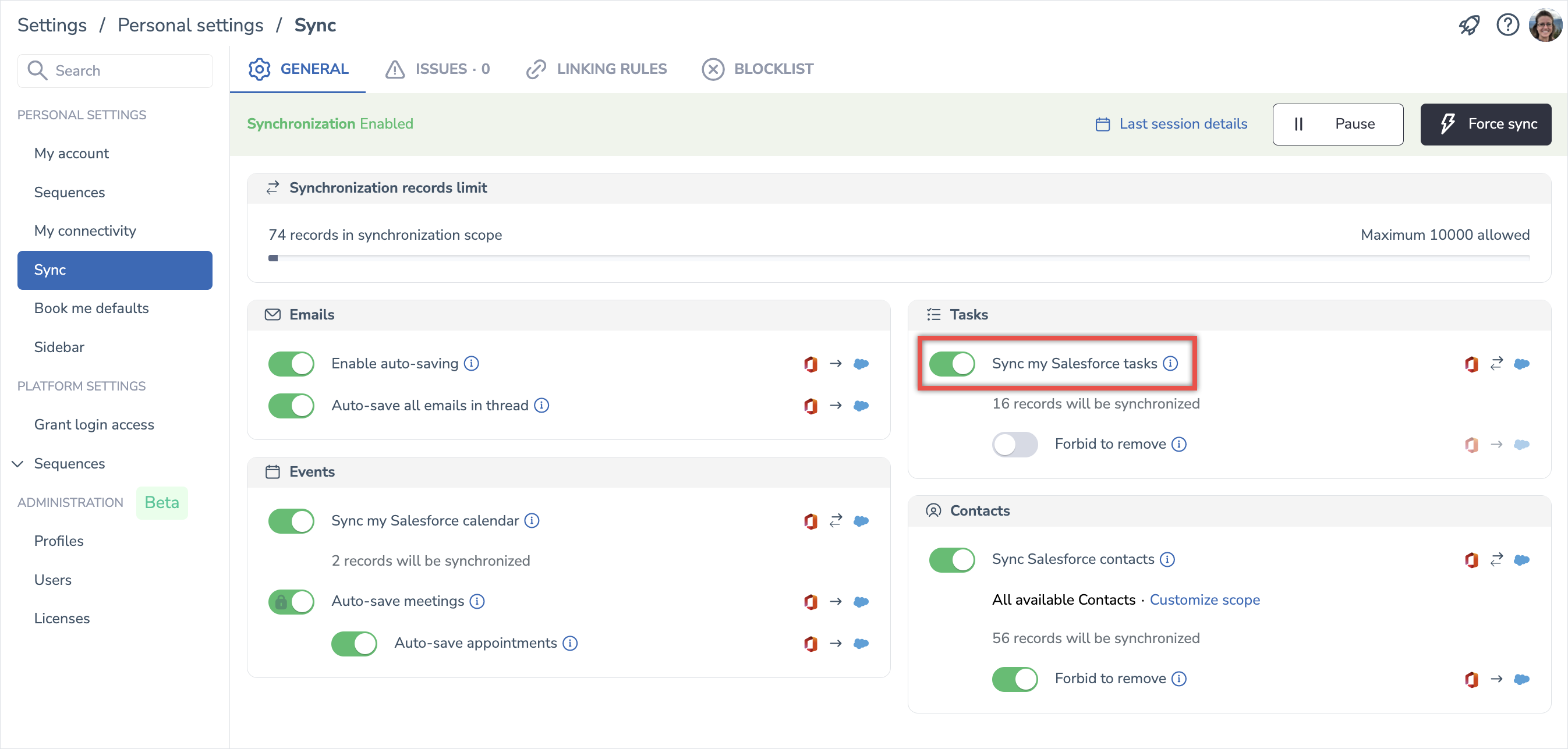
Note that your Tasks existing in Microsoft Exchange Server / Microsoft 365 prior to Context Sync activation will not be synced with Salesforce, unless you specifically select them to be synced using either one of the methods described below.
Save a task in Salesforce#
You can save a Microsoft Exchange Server / Microsoft 365 Task in Salesforce in one of the following ways:
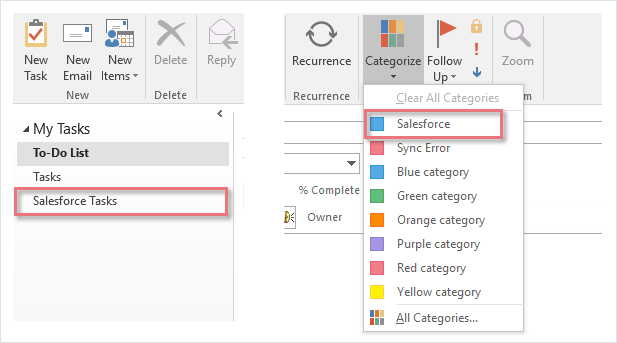
By assigning the task the custom Salesforce category. In this case on the following sync session the task will be saved in Salesforce and automatically moved to the Salesforce Tasks folder
By moving the task to the dedicated Salesforce Tasks folder. On the following sync session the task will be saved in Salesforce and automatically assigned the Salesforce category. As long as the task stays in the folder, any changes made to it will be conveyed to its matching Task object in Salesforce
Note
If the Salesforce category is unassigned after an item was moved to the dedicated Salesforce folder and synchronized with Salesforce, Context Sync will automatically restore the category on this item on the following sync session – items will remain synced if you just unassign the custom category from them but leave them in the dedicated folder.
In the opposite case, if a synchronized item is removed from the dedicated Salesforce folder to be unsynced, Context Sync will automatically remove the custom category from this item in MS Outlook on the following sync session.
Your personal Tasks located in the default Tasks folder or other folders in Microsoft Exchange Server / Microsoft 365 will not get saved in Salesforce. Only the Tasks assigned the Salesforce category or moved to the Salesforce Tasks folder will get saved.
Edit a Salesforce task through Context Panel#
You can edit a Salesforce task via Context Panel in one of the following ways:
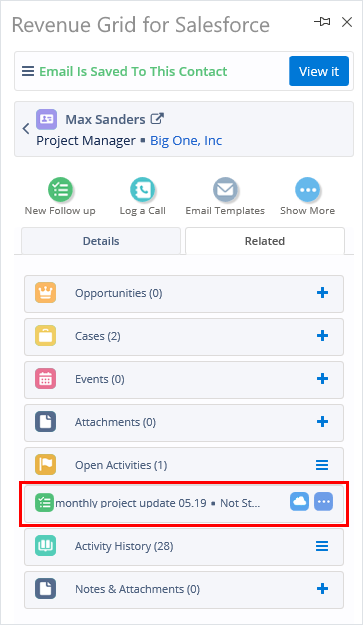
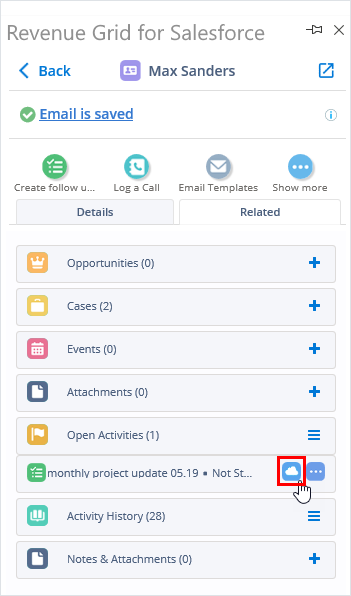
In Context Panel, expand a related record’s card, select the Related tab and expand the necessary Task under Open activities.
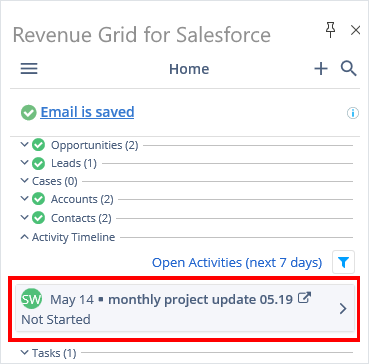
Find the needed Task among Open activities right on the Context Panel Home screen.
Open a task in Salesforce#
To open a task in Salesforce:
Find the necessary Task in the Context Panel using either of the ways described in the previous section.
Click the cloud icon or the open icon next to the Task’s header. The Task will be opened in Salesforce in your browser.
Note
Changes made to a task through Context Panel are conveyed to Salesforce immediately and do not require Context Sync to be active, while changes made to tasks in email client will appear in Salesforce only after the following sync session.
Tasks syncing limitations via Microsoft Graph#
The following task-related features are not supported when using Microsoft Graph:
Syncing recurring tasks
Syncing task categories