

Manage app integrations#
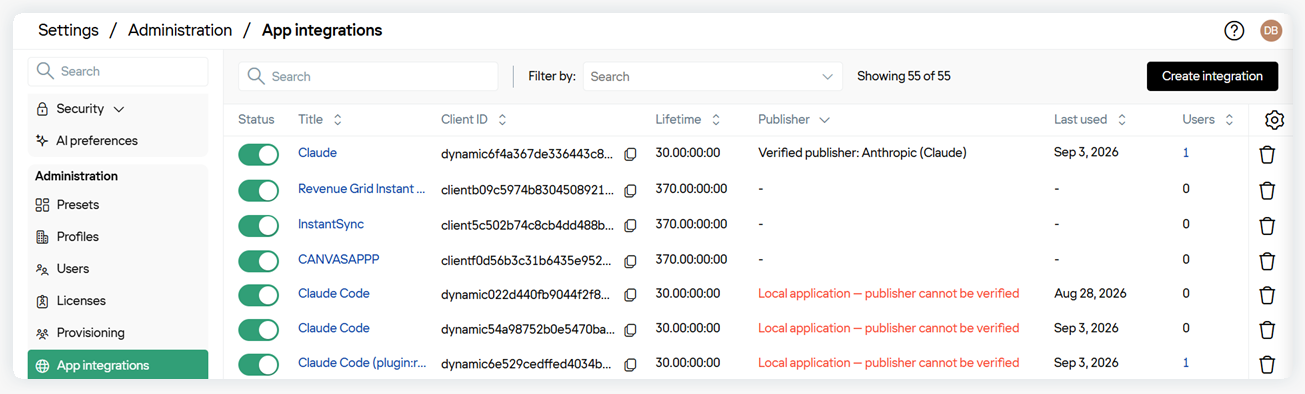
The App integrations page provides a central place to create and manage integrations for your Revenue Grid organization. Administrators can create integrations to obtain the client credentials required for supported integration scenarios and manage applications that connect to Revenue Grid through the Model Context Protocol (MCP).
For MCP applications, administrators can monitor connected applications, check publisher verification status and recent usage, and see which Revenue Grid users have authorized an application.
Prerequisite#
You must have a Platform admin role in Revenue Grid.
View app integrations#
To view app integrations:
Sign in to the Revenue Grid platform.
In the top-right corner, select the profile icon, and then select Settings.
Go to Administration → App integrations.
The page displays the following information:
Column |
Description |
|---|---|
Status |
Indicates whether the integration is enabled. |
Title |
The name of the integration or application. |
Client ID |
The unique identifier assigned to the client. |
Lifetime |
The configured lifetime of the integration. |
Publisher |
The publisher verification status for dynamically registered MCP applications. |
Last used |
The date when the MCP application was last used to access Revenue Grid. |
Users |
The number of Revenue Grid users who have authorized the MCP application. Select the number to view these users. |
Note
Publisher verification applies to dynamically registered MCP applications only. A publisher status isn’t displayed for integrations that don’t use dynamic registration.
Create an integration#
Administrators can create an integration to obtain the client credentials required for supported integration scenarios.
Important
The client secret is displayed only once — immediately after the integration is created. Copy and store it securely, as it cannot be viewed again later.
Sign in to Revenue Grid platform and open settings.
Navigate to Administration > App integrations.
Click Create integration in the top-right corner of the page.

Fill in the integration details:
Field
Description
Title
Enter a name for the integration (for example,
RG managed package).Client ID
Leave this field empty. It is generated automatically.
Client Secret
Leave this field empty. It is generated automatically.
Active
This field is read-only during creation and is enabled by default. You can disable it later if needed.
Lifetime
This field is read-only during creation. The default credential lifetime is 370 days. After the integration is saved, admins can reduce the lifetime if needed.
Click Save at the bottom of the form. After saving, the system will display the client ID and client secret.
Copy the client secret immediately after creation and store it securely. It will not be shown again after you close the dialog.
Manage MCP applications#
Filter MCP applications#
You can filter the list to view only dynamically registered MCP applications.
On the App integrations page, open the Filter by list.
Select Dynamic MCP only.

To display other integrations again, clear the filter.
Publisher verification statuses#
For dynamically registered MCP applications, the Publisher column indicates whether Revenue Grid recognizes the application’s publisher based on its registered destination.
The following statuses are available:
Status |
Description |
|---|---|
Verified publisher: Publisher name |
Revenue Grid recognizes the application’s publisher based on its registered destination. |
Unverified — this name was supplied by the app |
Revenue Grid can’t verify the publisher. The displayed application name was provided by the application during registration. |
Local application — publisher cannot be verified |
The application runs locally and doesn’t provide a remote destination that Revenue Grid can use to verify its publisher. |
An unverified publisher doesn’t prevent an application from connecting to Revenue Grid.
Publisher verification helps identify the publisher associated with an application. It doesn’t indicate that Revenue Grid has reviewed or certified the application.
View users who authorized an application#
The Users column shows how many Revenue Grid users have authorized an MCP application to access Revenue Grid.
To view users who authorized an application:
Select the number in the Users column for that application.

The same application client can be authorized by multiple Revenue Grid users. Each user manages their own authorization under Personal settings → Connected applications. For details, see Manage connected applications.
Remove an integration#
Administrators can remove an integration from the Revenue Grid organization.
To remove an integration:
On the App integrations page, find the integration you want to remove.
In the table actions, select the delete icon.

Confirm the action.
For MCP applications, removing an integration revokes its access to Revenue Grid. An access token that was issued before the integration was removed can remain valid until it expires.
Note
Removing an MCP integration affects the application at the organization level. For instructions on how to revoke only your own authorization for an application, see Manage connected applications.