

Ensure access to Revenue Grid after Salesforce connected app restrictions#
Starting in September 2025, Salesforce will block end users from using uninstalled connected apps. This affects organizations using Revenue Grid, which previously worked without being installed in Salesforce. To ensure uninterrupted functionality, Salesforce admins need to take action before the change.
This article explains what the change means, how it affects Revenue Grid users, and what to do to keep access working.
What is changing in Salesforce#
Salesforce is making a security change that limits how users can access apps that are not installed in their Salesforce org (called “connected apps”).
Here’s what to know:
Most users won’t be able to use uninstalled connected apps.
Users can use an uninstalled app only if:
They connected to it before the change.
The app does not use a specific login method called OAuth 2.0 device flow.
These changes help protect Salesforce data by blocking access to apps that haven’t been approved.
For details, see the official Salesforce article on connected app restrictions.
Impact on Revenue Grid users#
Revenue Grid connects to your Salesforce org as a connected app. It does not use the OAuth 2.0 device flow, which means:
Users who previously connected Revenue Grid to Salesforce may continue to use it temporarily, even if the app remains uninstalled.
New users will be blocked from connecting if the app is not installed.
To ensure uninterrupted access for all users—both new and existing—Salesforce admins should install the Revenue Grid app in advance of the restriction.
Why install the Revenue Grid app#
Installing the Revenue Grid for Salesforce app ensures uninterrupted access after the Salesforce restriction takes effect. It also gives admins better control and visibility into how the app is used in the org.
After installation, admins can:
Manage who can use the app
Configure access so that only selected users—based on profiles or permission sets—can use Revenue Grid.
Enforce IP restrictions and session policies
Apply IP restrictions, control refresh token lifetimes, and define other OAuth policies to align with your org’s security standards.
What happens if you don’t install the Revenue Grid app#
If the Revenue Grid app is not installed before the restriction:
Users who have not previously authorized the app will be blocked.
Users may encounter access and authorization issues when attempting to connect.
Verify Salesforce admin permissions before managing the app#
Salesforce introduced a new user permission called Approve Uninstalled Connected Apps. Admins without this permission may be unable to view, approve, install, or manage uninstalled connected apps in Salesforce.
This permission is automatically included only in the standard System Administrator profile. Custom admin profiles, including profiles cloned from System Administrator, do not receive this permission automatically.
Before checking, installing, or managing the Revenue Grid connected app, verify that the Salesforce admin performing these actions has the Approve Uninstalled Connected Apps permission assigned.
Important: We recommend assigning this permission only to trusted administrators or users responsible for managing connected app integrations.
To verify the permission:
Open Salesforce Setup.
In the Quick Find box, search for and select Profiles.
Open the profile assigned to the Salesforce admin performing the installation or app management.
Under Administrative Permissions, verify that the
Approve Uninstalled Connected Appssystem permission is enabled.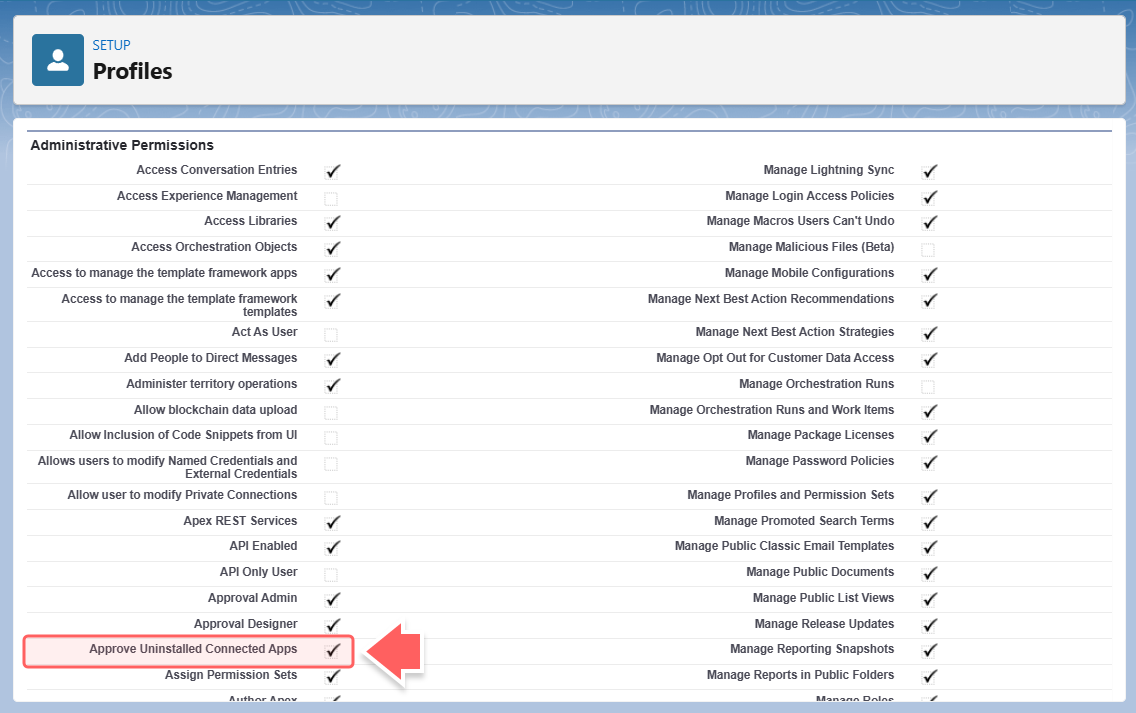
Check if the Revenue Grid app is installed in Salesforce#
To determine whether Revenue Grid is currently installed:
Open Salesforce Setup.
In the Quick Find box, search for and select Connected Apps OAuth Usage.
Locate the Revenue Grid for Salesforce (or Revenue Inbox for Salesforce) app in the list.
Note
If the page or app details are unavailable, verify that your Salesforce admin account has the Approve Uninstalled Connected Apps permission assigned.
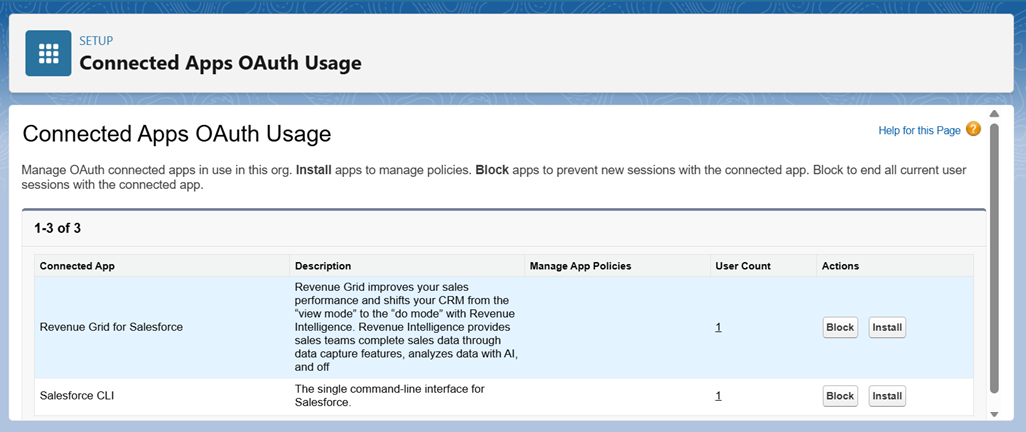
In the Action column:
If you see an Install button, the app is not installed, and you need to install it.
If there is no Install button, the app is already installed.
Install the Revenue Grid connected app in Salesforce#
If the Revenue Grid for Salesforce app is uninstalled:
In Connected Apps OAuth Usage, find the Revenue Grid for Salesforce (or Revenue Inbox for Salesforce) app.
Click Install next to the app name. Salesforce displays an installation page.
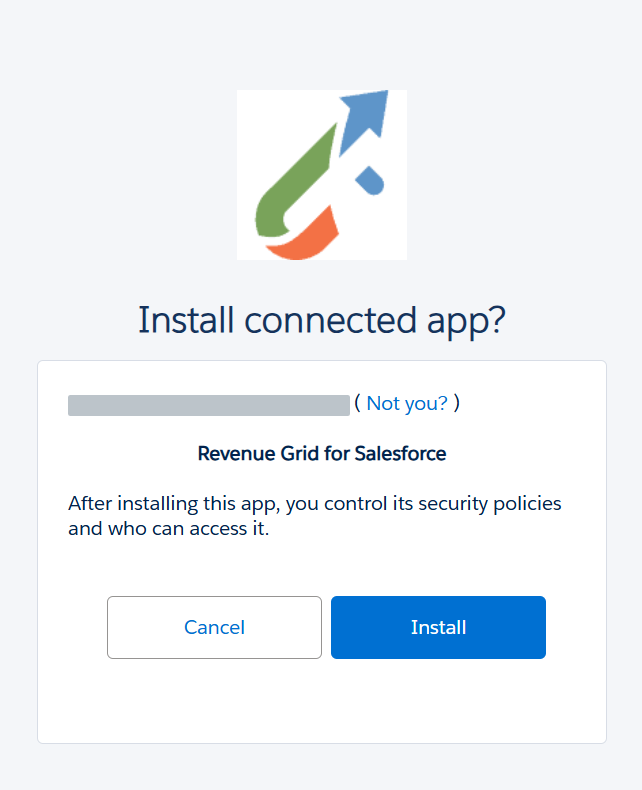
Click Install again to complete the process.
Once installed, the app becomes fully supported for all users and is not affected by the usage restriction.
(Optional) Manage access to Revenue Grid after installation#
By default, after installing the Revenue Grid app, all users in your Salesforce org can authorize and access it on their own. If you want to control who can use the app, you can switch to the Admin approved users are pre-authorized option.
Caution
Switching to the Admin approved users are pre-authorized option immediately revokes access for all current users until access is explicitly granted through user profiles or permission sets. Be sure to configure user access first to avoid service disruption:
To assign access via profiles, edit each profile’s Connected App Access list.
To assign access via permission sets, edit each permission set’s Assigned Connected Apps list.
For more information, see Manage Access to a Connected App.
To choose how users are authorized to access the app:
In Setup, search for and select Manage Connected Apps.
Click Edit next to Revenue Grid for Salesforce (or Revenue Inbox for Salesforce).
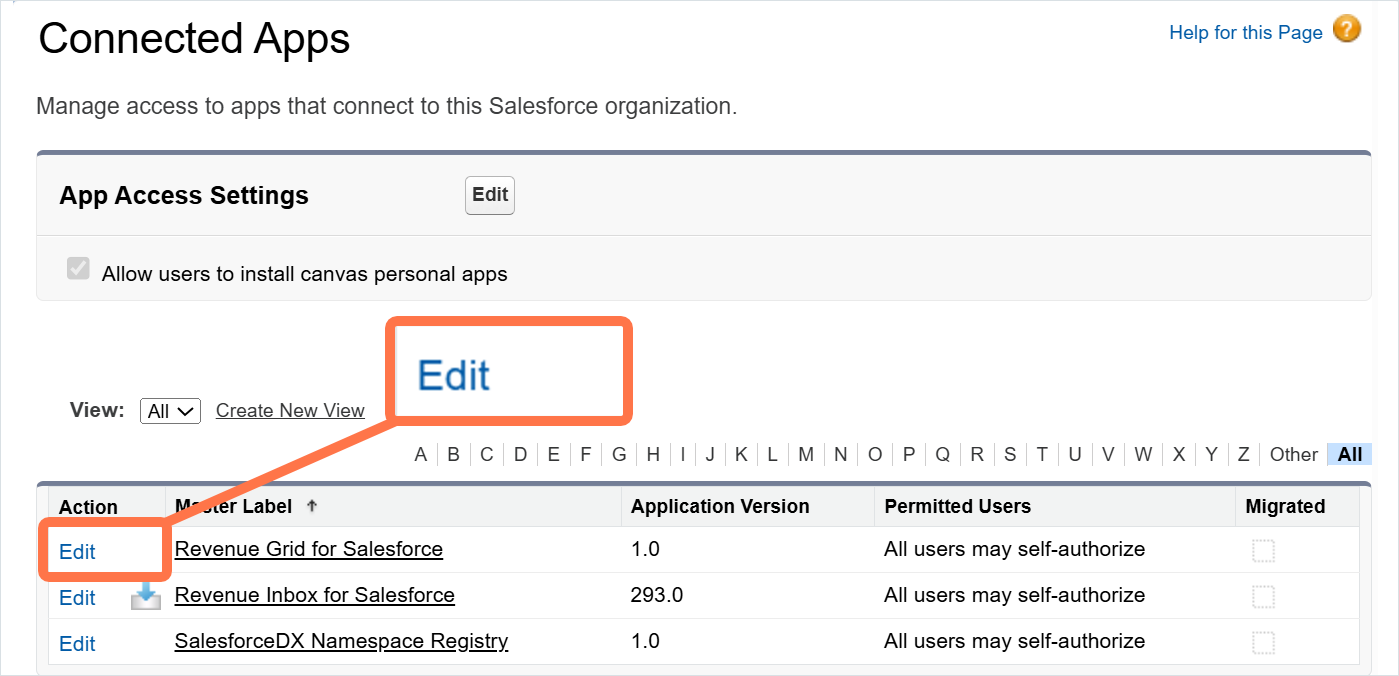
Under OAuth Policies, open the Permitted Users dropdown.
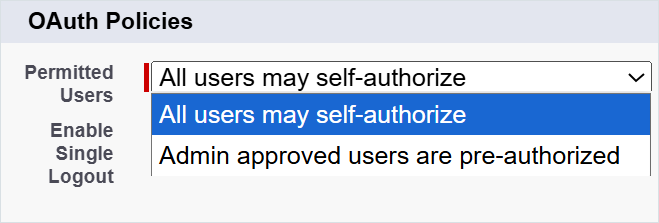
Choose one of the following access settings:
All users may self-authorize (default)
This option allows any user in the org to connect to the app after successfully signing in. Users must approve the app the first time they access it.
Note
If users have already authorized the app, their existing access continues to work.
Admin approved users are pre-authorized
This option allows admins to grant access only to users with specific profiles or permission sets.
Caution
Switching to the Admin approved users are pre-authorized option immediately revokes access for all current users until access is explicitly granted through user profiles or permission sets. Be sure to configure user access first to avoid service disruption:
To assign access via profiles, edit each profile’s Connected App Access list.
To assign access via permission sets, edit each permission set’s Assigned Connected Apps list.
For more information, see Manage Access to a Connected App.
Select Save.
Troubleshoot Revenue Grid connected app access and installation issues#
App is uninstalled or blocked#
Symptoms#
Users see the following message during Salesforce authorization:
“We can’t authorize you because of an OAuth error. For more information, contact your Salesforce administrator. OAUTH_APPROVAL_ERROR_GENERIC: An unexpected error has occured during authentication. Please try again.”
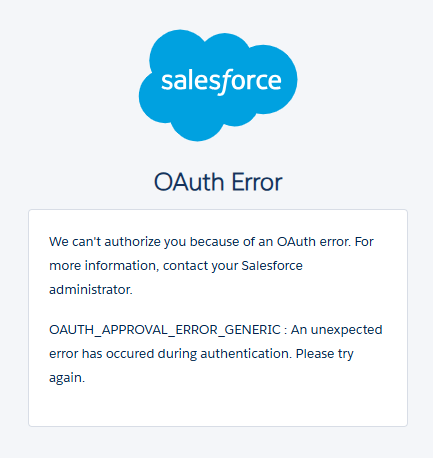
The redirect URL includes:
error=invalid_clienterror_description=app must be installed into org
Cause#
The Revenue Grid connected app is not installed in the Salesforce org, or Salesforce blocked access because of the connected app usage restriction.
Resolution#
A Salesforce admin must install the Revenue Grid connected app in the org.
App is blocked by admin policy (API Access Control)#
Symptoms#
Users are redirected to the app callback URL (redirect_uri) with the following URL parameters:
error=OAUTH_APP_BLOCKEDerror_description=this app is blocked by admin
Cause#
API Access Control is enabled in your org and the Revenue Grid app hasn’t been allowlisted.
Resolution#
A Salesforce admin must update the API Access Control settings to allow the Revenue Grid connected app.
App is installed, but access is not granted#
Symptoms#
Users see the following error during authorization:
“Error: OAUTH_APP_ACCESS_DENIED”
The redirect URL includes:
error=OAUTH_APP_ACCESS_DENIEDerror_description=user is not admin approved to access this app
Cause#
The connected app is configured with the Admin approved users are pre-authorized setting, but the user was not granted access through a Salesforce profile or permission set.
Resolution#
A Salesforce admin must grant users access to the Revenue Grid connected app through profiles or permission sets. See (Optional) Manage access to Revenue Grid after installation.
Revenue Grid connected app does not appear in Connected Apps OAuth Usage#
Symptoms#
The Revenue Grid connected app does not appear on the Connected Apps OAuth Usage page in Salesforce Setup.
Cause#
The Salesforce admin uses a custom profile that does not include the Approve Uninstalled Connected Apps system permission. Without this permission, Salesforce may hide uninstalled connected apps from the Connected Apps OAuth Usage page.
Resolution#
Verify that the Salesforce admin profile includes the Approve Uninstalled Connected Apps system permission. See Verify Salesforce admin permissions before managing the app.
After enabling the permission, reopen the Connected Apps OAuth Usage page and check for the app again.
Frequently asked questions#
Does Revenue Grid use the OAuth 2.0 device flow?
No. Revenue Grid does not use the OAuth 2.0 device flow. As a result, previously authorized users may retain access after the restriction—but only temporarily if the app is not installed.
Do we still need to install Revenue Grid if it works now?
Yes. To ensure full access for all users and prevent future disruption, the app must be installed as a connected app.
What if nothing is done?
New users will be blocked from accessing Revenue Grid. Existing users may keep access temporarily.
Does Revenue Grid need to be reinstalled if it was already installed before the change?
No. If the app was already installed before the change, no further action is needed for that org.